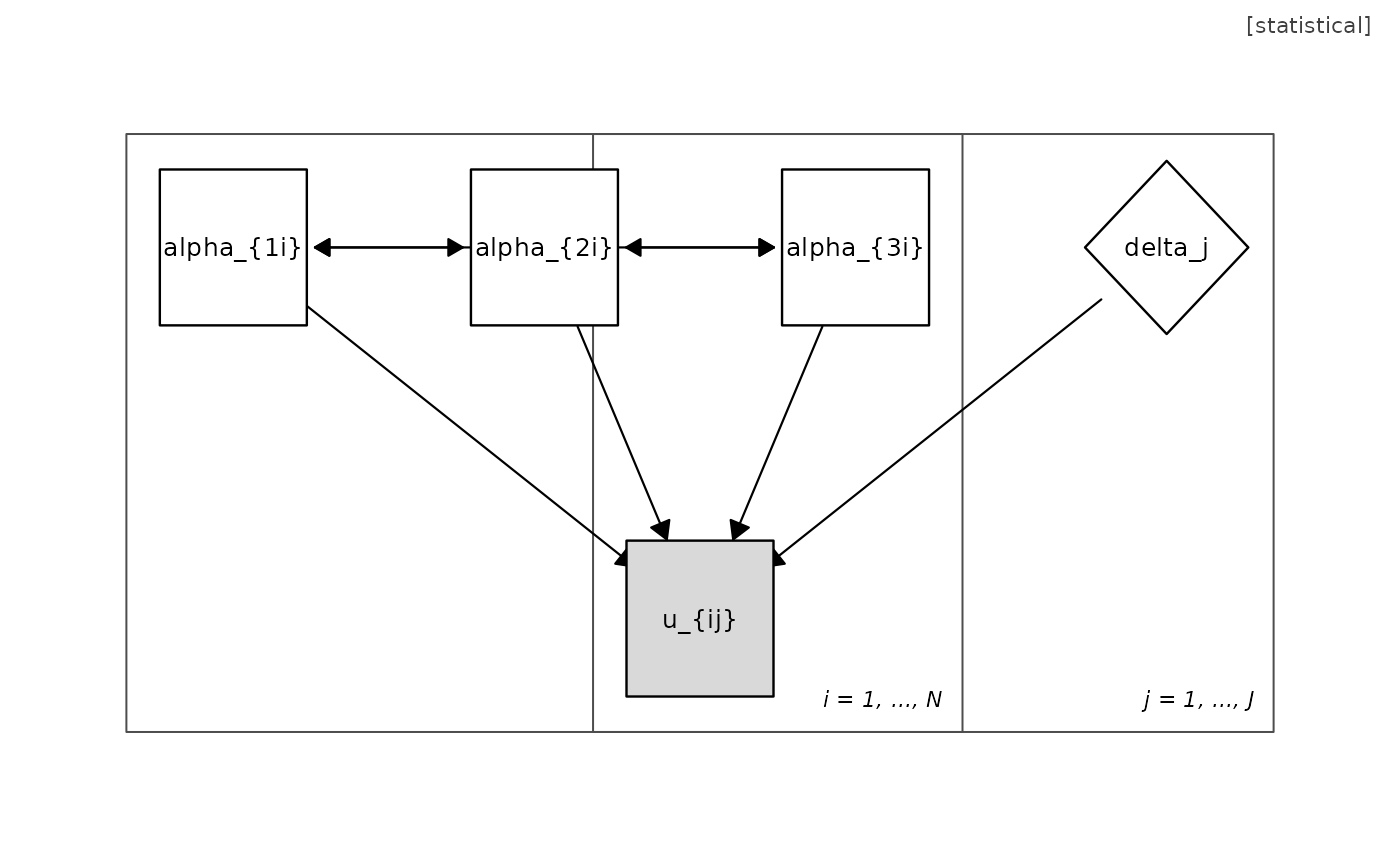
Builds a diagnostic classification (cognitive diagnosis) model: several binary latent attributes (latent categorical vertices) govern, through a Q-matrix, the observed item responses at the crossing of person and item plates. Item parameters are fixed unknowns in the item plate. This combines a latent categorical structure with the crossed-plate measurement form, a structure no single classic convention can draw.
Arguments
- Q
A K-by-J 0/1 Q-matrix: rows are attributes, columns are items;
Q[k, j] = 1if itemjrequires attributek. Note that this is the transpose of the J-by-K (items-by-attributes) layout used by, for example, the GDINA and CDM packages; a warning is issued when the supplied matrix has at least as many rows as columns, the usual sign of the transposed convention. Because the diagram shows the generic response vertexu_ijrather than per-item vertices, the Q-matrix is collapsed to the attribute level: attributekpoints atuwhen at least one item requires it. Defaults to a 3-attribute, 6-item example.- attr_cov
Logical; draw pairwise covariance edges among the latent attributes (default
TRUE), reflecting the saturated (or higher-order) attribute distribution that standard DCMs assume. Set toFALSEto draw independent attributes.- plate_index
Index label for the person plate.