
Hsiu-Ting Yu 游琇婷
I develop, evaluate, and teach statistical and psychometric methods for psychological science: latent variable and multilevel models, psychometric networks, the dynamics of within-person change, and the quality of measurement and evidence. The aim is simple to state and hard to achieve: conclusions that survive their own assumptions.
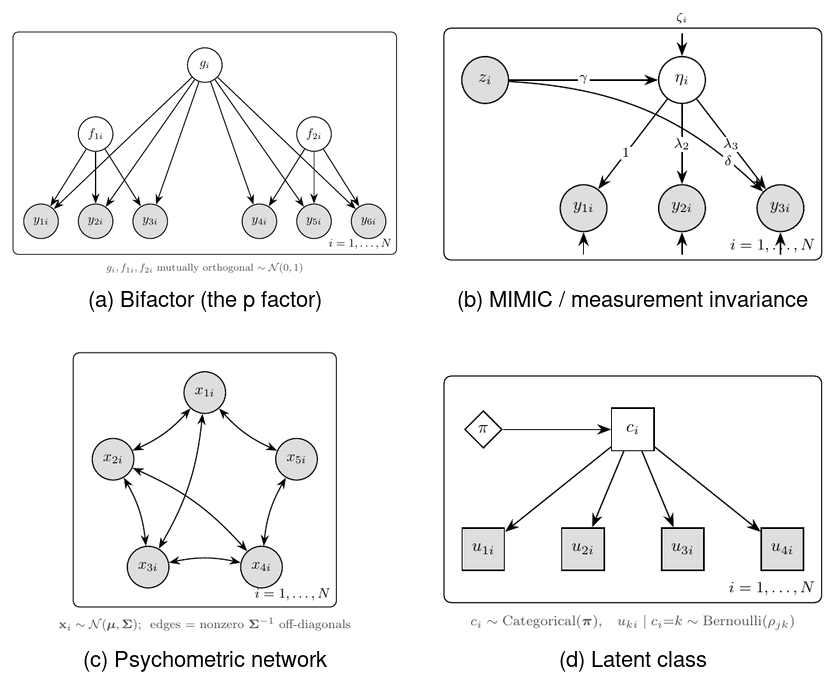
Four axes, one question
Under what conditions does a statistical or psychometric method recover what it claims to recover, and what happens to substantive conclusions when its assumptions fail? The lab pursues that question along four axes and turns the answers into design guidance, sample size rules, model comparisons, and software.
Nested and dependent data
Multilevel latent class and mixture models, mixed-effects specification, dependency indices, and the cost of ignoring structure.
Construct representation
Factors versus networks: when the two representations are distinguishable, and how networks can be compared across groups and levels.
Within-person dynamics
Intensive longitudinal and single-case designs, the shape of change, and continuous- versus discrete-time modeling.
Evidence quality and synthesis
Research synthesis under dependence and selection, reliability reporting, and detection of invalid survey responding.
Open-access textbooks, read online
Quantitative Psychology: Measurement, Models, and Inference
Tools that make the methods usable
umg R package
A unified graphical grammar for statistical models: one lexicon of nodes, edges, and plates that renders CFA, SEM, IRT, multilevel, mixture, and Bayesian models consistently across TikZ, ggplot2, and DiagrammeR backends. Submitted to CRAN; under review.
silentema R package
Dynamic missingness graphs and sensitivity analysis for informative nonresponse in ecological momentary assessment data: declare the nonresponse mechanism, check which estimands remain recoverable, test whether skipped prompts were informative, and profile estimates over a self-censoring parameter. Submitted to CRAN; under review.
MDLV toolbox MATLAB
Models with discrete latent variables for categorical data: a common framework and estimation toolbox for latent class, latent transition, and multilevel extensions (Yu, 2013, Behavior Research Methods).
Representative work
- Yu, H.-T. (in press). Evaluating statistical methods for single-case designs under serial dependence: Precision, validity and sensitivity. Psychological Methods.
- Yu, H.-T., & Yo, T.-S. (2026). Methodological implications of generative AI and large language models for psychological research: Redefining inferential conditions and boundaries. Chinese Journal of Psychology, 68(2), 107–123. [In Chinese] doi:10.6129/CJP.202606_68(2).0003
- Park, J., & Yu, H.-T. (2018). Recommendations on the sample sizes for multilevel latent class models. Educational and Psychological Measurement, 78(5), 737–761. doi:10.1177/0013164417719111
- Yu, H.-T., & Park, J. (2014). Simultaneous decision on the number of latent clusters and classes for multilevel latent class models. Multivariate Behavioral Research, 49, 232–244.
- Yu, H.-T. (2013). Models with discrete latent variables for analysis of categorical data: A framework and a MATLAB MDLV toolbox. Behavior Research Methods, 45, 1036–1047.
- Anderson, C. J., & Yu, H.-T. (2007). Log-multiplicative association models as item response models. Psychometrika, 72, 5–23.
Teaching
Psychological testing, hierarchical linear modeling, statistics for psychology and education, and advanced psychometrics at NCCU; previously multilevel modeling and advanced statistics at McGill. Workshops for City University of Hong Kong and professional societies in Taiwan.
Join the lab
The lab welcomes graduate students and collaborators who want to work on measurement, latent variable and multilevel modeling, longitudinal dynamics, or the methodology of psychological research, and who are willing to learn to simulate, estimate, and write.